
Moana's Transformation
How Moana does self-acceptance better than KPDH

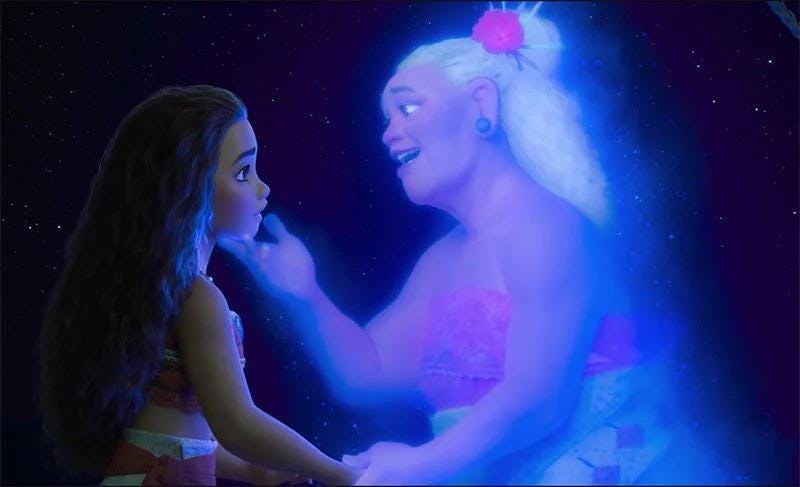
In my KPDH post, I mentioned Moana as a classic example of the self-acceptance character arc in film, especially for younger audiences. But I didn’t explain how Moana exemplifies the pattern wherein self-acceptance gives the hero a tool for the final challenge, rather than self-acceptance itself being the tool. I skipped it because Into the Spider-Verse demonstrates the principle so cleanly, whereas Moana handles it more subtly. But rewatching Moana’s last act gave me a deeper appreciation for how well it’s done.
Throughout the movie’s first two acts, Moana sees herself as secondary to Maui. She states her goal explicitly more than once: “You [Maui] will board my boat, sail across the sea, and restore the Heart of Te Fiti.” Maui is the master wayfinder who will do all this; Moana will just goad him into doing it. She’s the sidekick.
Then, after a failed attempt to pass the barrier island guarded by Te Kā, Maui abandons her. In this moment of greatest despair, Moana gives the Heart of Te Fiti back to the Ocean. That’s when Grandma Tala’s ghost appears and helps Moana understand who she is, leading her to sing, “And the call isn’t out there at all, it’s inside me!” This is the moment of self-acceptance, but it’s more than that – it’s a reframing of the whole quest. She doesn’t need Maui to continue. She will do it on her own.
She summons all her wayfinding powers to repair the boat, outmaneuver Te Kā, and get past the barrier island – a feat she’d believed only Maui could pull off. And only then does Maui return. This is the hinge: by conquering this challenge alone, she flips the dynamic. Now Moana is the hero and Maui the sidekick.
Notice that Maui doesn’t come back and say, “Great, you got past the barrier island, now hand over the Heart and I’ll do the rest.” No, he’s only there to distract Te Kā while Moana takes the lead. Her self-acceptance doesn’t lead directly to her success in the final challenge, but it alters the field of play in a crucial way that prepares her to meet it.
And, of course, it turns out that Te Kā is not just the barrier that stood in the way – because Te Kā is, in fact, Te Fiti without her heart. So the final challenge “melds back into” the hurdle that Moana overcame to get there. This might make it seem like Moana’s self-acceptance leads directly to the final challenge – but that’s a mistake. We have to look at it from Moana’s POV (which is also the first-time viewer’s POV). From that perspective, Te Kā is merely the penultimate challenge, Te Fiti the final challenge. Thus, Moana’s self-acceptance allows her to accomplish a feat (evading Te Kā solo) to gain a new tool (Maui’s return as her sidekick) to face the ultimate test (replacing the Heart).
That extra step – where the breakthrough changes the landscape instead of ending the story – is what KPDH needed and skipped.
I had forgotten about Moana and went straight to Mulan for well done coming of age stories. But yeah, Moana is top tier. I’m hearing from my hubs, they are done filming the live action movie. Hubs mentioned Miles Morales too when mentioning well done story arc of self acceptance.